


The Land Remembers
Circular Heroes: The Afterlife of Your Wardrobe
Written by Martina Thomas, edited by Karini Viranna
Photos provided by Circular Heroes
Discarding waste in someone else's space to protect your own follows a simple logic: "I do not want this in my surroudings, so I will make it your problem". This same dynamic is now borderless, with the Global North exporting its waste to the Global South, which must process discarded products it did not originally use. Discourse often treats colonialism as a finished chapter in history, overlooking its enduring legacies and contemporary manifestations. Yet treating it as a forgotten memory ignores the scars that still define the global landscape. Though often perceived as healed, these wounds have hardened into systemic foundations, operation as a persistent reality for the Global South.
THE WORKSHOP
Born of a visceral synergy between Rafael Edem Kouto and Peter D. Abayomi, Circular Heroes operates at the intersection of ecological necessity and decolonial practice. Centred on the seaside community of the Isale Akoka area in Bariga – a busy district suburb in Lagos, Nigeria, known for aquatic
activities and floating homes – this workshop project aims to position the local youth as leaders in closing the circular economy loop. Within the current geopolitical paradigm, the Global North often perceives the Global
South as a repository for its industrial surplus. Circular Heroes offers a radical proposition, challenging the perception of this waste.
Kouto, a creative director of Swiss, Togolese and Ghanaian origins, measures the impact of the project through the tension of a paradox. The viewer’s admiration for the work collides with the internal contradiction that these arte- facts are contingent upon the very refuse that global systems are designed to obscure. The vision for Circular Heroes is predicated upon
the existing foundation of Abayomi’s Eran Jije Project. Abayomi, a multi-disciplinary artist from Lagos, uses provocative urban materials and site-specific approaches to address pressing social issues.
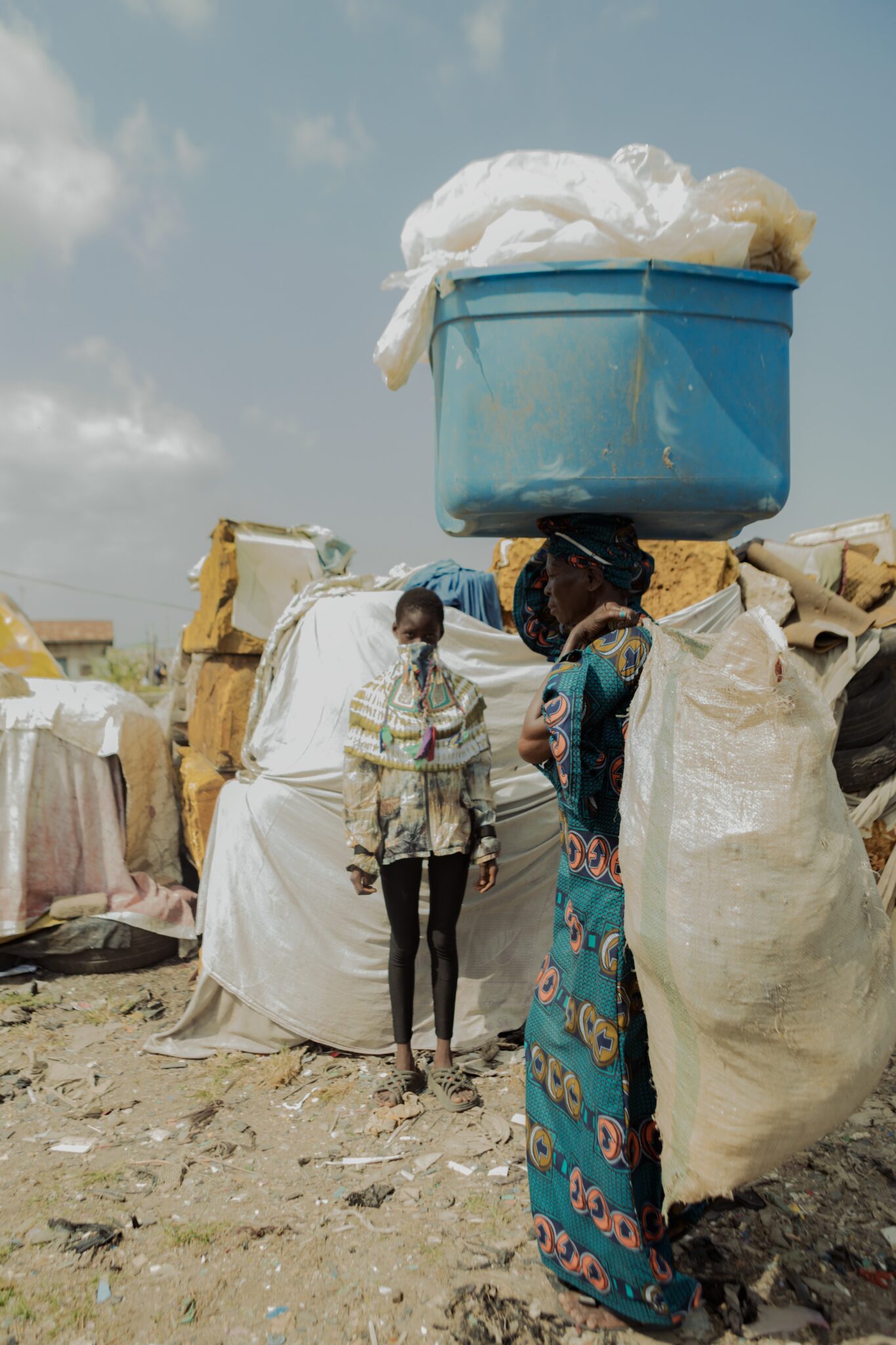
Circular Heroes is not just a workshop, but a way of reimagining waste as a resource for creativity and expression. At its core, the project seeks to give these young participants visibility, celebrating and acknowledging their often-overlooked contributions to environmental and climate discourse. Back in Bariga, the youth go through a process of material reclamation. The workshop opens with an exchange of perspectives and an introduction to the project and its history. Next are collaborative discussions in separate groups where brainstorming sessions take place. Participants find and supply their own materials, and through artisanal practices like appliqué and collage, waste like planks, electronics, textiles and plastic are converted into musical instruments, wearable tech and couture. Ultimately, the project participants execute a bold refusal of invisibility.
AFTERLIFE CONNECTIONS
Facilitated by the Pro Helvetia Johannesburg Residency, Kouto’s three-month research across Ghana and Nigeria serves as an enquiry into decoloniality in fashion. Through Circular Heroes, he interrogates the legacies of the discarded, tracing the invisible links between consumer habits and the afterlife of objects, long after their perceived utility has ended.
While the community in Bariga navigates waste as a medium of survival, the project provides a symbolic closure. Kouto’s purpose is to destigmatise the refuse of the Global North by reactivating the soul of the material and giving it a new life. Yet, this creative rebirth stands in stark contrast to the physical
destruction of the landscape. Today, the Isale Akoka waterfront stands under the shadow of a state-led redevelopment. Following a March 2025 state mandate to clear out structures within 100 metres of power lines, a sustained campaign of demolitions has pushed thousands into homelessness with little to no prior warning. Often executed under the guise of essential sanitation, these actions have threatened to dismantle the very community that birthed this vision.
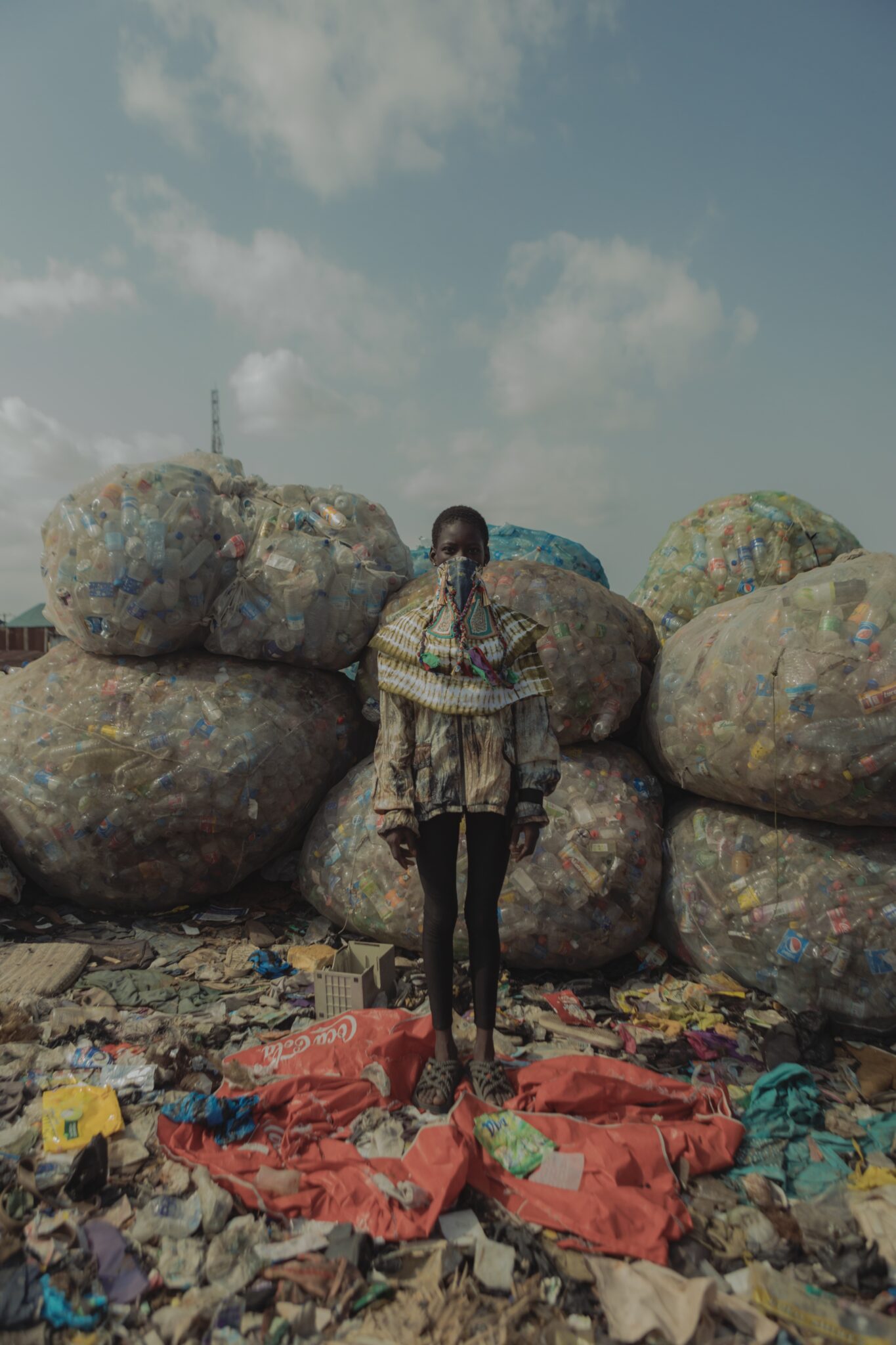
Photographer Ruby Okoro provides the visual vocabulary for Circular Heroes. The portraits of Gbénga Olátúnjí and Nífèémi Okùn-Omo serve as contemporary icons holding scarves made during the first two workshops in Lagos. One striking portrait features telephonic components, reimagined as luminous halos, symbolising the participants as figures of ligh and hope. Another features a scarf with a portrait and orbiting plastic bottles with embellishments made from waste. The participan wears headphones made from Coca-Cola cans, which produce sound when connectedto digital gear. Daniel Akpan, with a mask in the background, represents a masquerade used during the moonlight plays in Bariga.
The lack of corporate transparency has established the Global North as the primary generator of waste. This often manifests in the intentional disposal of materials into marine ecosystems. Inevitably, it migrates to the coastlines of vulnerable regions. Despite the clarity around this trajectory, there has been a prominent absence of accountability regarding the root drivers of this crisis.
ONWARDS
Emerging from the shadows of colonialism and reaching for the light of reclamation, the team of Circular Heroes wishes to take this project forward. With its inclusion in the Ras Al Khaimah Art Festival in the UAE, the team envisions Circular Heroes as an evolving travelling project, with the hope of one day bringing it back to Lagos, where it first began. By showcasing this project in Berlin, the team wishes to remind us that even though the soil might be burdened by the weight of what is discarded, it also carries the heaviest imprints of the most vibrant stories. The children of Bariga have left a mark that the land cannot forget. Amidst the calamity of waste colonialism, there exists an undeniable power to forge something transcendent.


Get DADDY in your Inbox
Stay in the loop by subscribing to our newsletter
